Announcing our new Research and Collections Centre
Director of Education Will Tosh introduces the new Research and Collections Centre at Shakespeare’s Globe.
This week something unexpected happens: a new library opens its doors.
It’s usually a different story. About forty libraries close for good every year in the UK. London has lost twenty in the past five years. As these sources of knowledge and imagination disappear, misinformation and dubious AI pseudo-facts proliferate online.
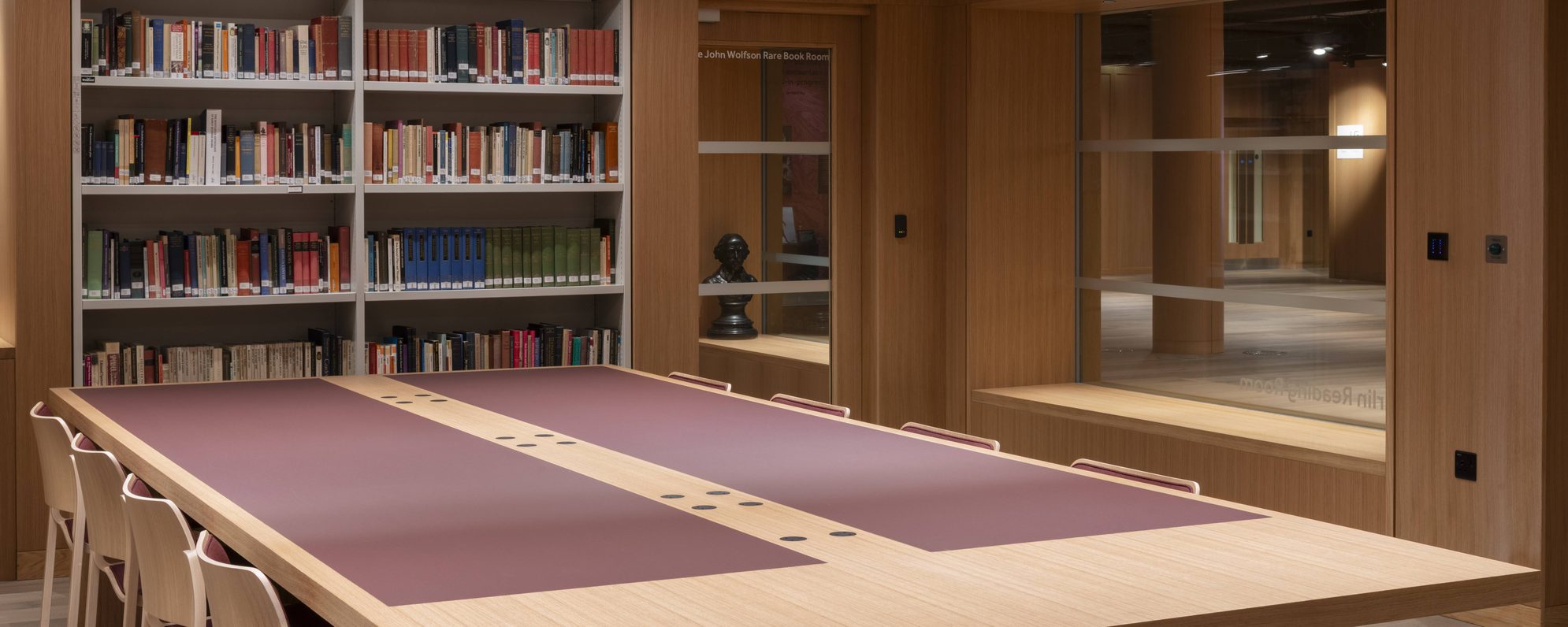
But from 22 September, we’re welcoming readers into the Audre D. Carlin Reading Room at Shakespeare’s Globe, part of our dazzling new Research & Collections Centre.

Photos by James Newton
Actually, let’s scrap that impersonal term ‘readers’. I’d like our first visitors to be you. It’s a matter of moments to book a morning or afternoon visit (or stay around for days). In this warm, timber-clad, deeply calming space, you’ll have access to over six thousand books about Shakespeare, early modern literature and culture, and the history of dramatic performance across the world. You can consult our Performance Archive that includes all the documents of production generated in making work at the Globe (prompt books spattered with stage blood, wardrobe bibles made fat with fabric swatches, musical scores bearing unique compositions) as well as our unsurpassed digital archive of performance – recordings of productions, public talks, workshops, events and more. Our library of original Renaissance texts, housed in the John Wolfson Rare Book Room, is the closest thing we have to Shakespeare’s bookshelf: nearly five hundred 16th and 17th century plays, poems, novellas, treatises, and works of history, philosophy and religion, beautifully preserved and kept in the kind of cool and low-lit conditions that are kind to ancient paper and equally kind to jaded humans.

Photos by James Newton

Photos by James Newton
Our Research & Collections Centre is a brand-new home for London’s only dedicated Shakespeare library. Accessible and free to any interested visitor, the new Centre brings to life Sam Wanamaker’s original vision for a purpose-built research institute at the Globe. The reading rooms sit alongside the state-of-the-art Wolfson Lecture Theatre, a climate-controlled secure archive store, office accommodation for our brilliant Collections team, and the stunning Weston Foyer, lined with honey-coloured oak and generous show-cases that display some of the most fascinating objects in our institutional and artistic archives. Hundreds of school pupils and university students have already enjoyed activities in our new facilities.

Photos by James Newton
Research has been a priority for Shakespeare’s Globe since our founder Sam Wanamaker commissioned an academic team to conduct one of the largest scale arts and humanities research projects of the 1980s and 90s: the reconstruction of Shakespeare’s 1599 Globe Theatre. Without that work we wouldn’t have either of our two iconic playhouses, and our experts continue to work side-by-side with our artists in an ongoing exploration of Shakespeare’s world and works. We remain the only theatre in the world housing a diverse cohort of resident scholars with an international reach, and a major intellectual partner in King’s College London (with whom we co-run the Shakespeare Centre London). Our scholarship drives forward conversations about Shakespearean performance in the world today, and models the use of Shakespeare’s work in debates about race, sexuality, gender, climate and health. And crucially, our research is proudly public-facing: we’re committed to making scholarship and expert knowledge accessible.

Photos by James Newton

Photos by James Newton
The inviting spaces of the Research & Collections Centre, and especially the reading rooms with their plate-glass frontages, make gloriously visible our belief that research and learning should be open to all. In recent years our research has stimulated the now biennial Shakespeare and Race festival (the 2026 festival kicks off in October). It has inspired agenda-setting books, and prompted the development of a new kind of education programme for lifelong learners, our Shakespeare and the Stages of Life course in 2026 and Shakespeare and the Natural World, which will run from April to July 2027. In the past decade we’ve trained, supervised and mentored more than one hundred early career scholars, who now work in universities around the world. Our One Globe First Book Fellowship supports an emerging scholar with the research for their first book. Our Master’s degree programme, twenty-five years old and taught in conjunction with King’s College London, is the most popular course of its kind in the UK. It’s a tough time for the arts and humanities in schools and universities, but I’m very proud that the Globe remains a beacon of humane, impactful, necessary and inclusive scholarship.

Photos by James Newton
There’s more to come. Thanks to support from the National Lottery Heritage Foundation, we’ll soon be announcing new activities designed to tell the story of the Globe, and of Shakespeare around the globe. The NLHF joins our honour-roll of supporters who have made the building and running of the Research & Collections Centre possible: thank you to The Brian Mitchell Charitable Settlement, The David and Claudia Harding Foundation, The Garfield Weston Foundation, The Gladys Krieble Delmas Foundation, The Loveday Charitable Trust, The Wolfson Foundation, and anonymous supporters. I should add that it’s still possible to name a seat in the Wolfson Lecture Theatre, and make your own contribution to learning and discovery at the Globe.

Photos by James Newton
I really hope you’ll be able to visit the Research & Collections Centre the next time you’re on Bankside. We’ve made a new home for a part of the Globe that’s very dear to our heart, and I can’t wait to share it.
The Research & Collections Centre was designed by architects Allies and Morrison whose high-profile projects include the Sam Wanamaker Playhouse, the Royal Festival Hall Transformation, the London College of Fashion, and the redevelopment of King’s Cross. Current work includes projects at the Barbican Arts Centre, Orange Tree Theatre and new studios for BBC Music at East Bank. Construction was completed by Beardwell Construction, with project management provided by Ingleton Wood.


